


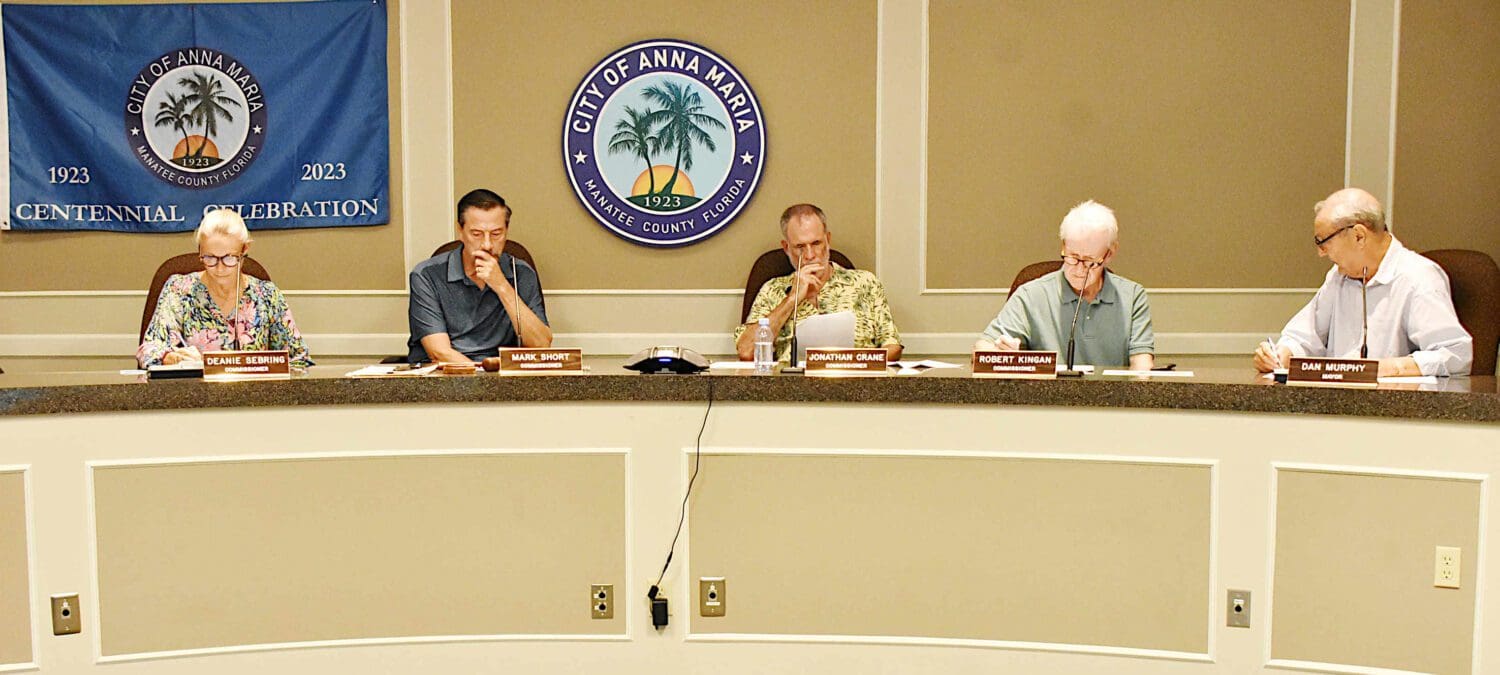
Incentivizing full-time residents presents challenges
ANNA MARIA – City officials are still exploring incentives that might be pursued in hopes of retaining current full-time city residents and attracting new ones.
The mayor and city commission have held three discussions on the possibility, legality and financial feasibility of offering property tax breaks, grants and/or additional building use allowances as incentives. In exchange for those incentives, the city would seek from property owners a voluntary restrictive covenant that would prohibit the property from being used as a short-term vacation rental for 20 to 30 years.
On June 22, Commissioner Charlie Salem initiated the first discussion about incentivizing full-time city residents and those who rent their homes to others on a long-term or annual basis, which in turn might provide more on-Island housing for Island employees.

Salem shared a one-page document citing U.S. Census Bureau data that shows Anna Maria’s population declined from 1,814 in 2,000 to 1,504 in 2010 and to 968 in 2020. Mayor Dan Murphy recently stated that 70% of Anna Maria’s residential dwellings are short-term vacation rentals.
Salem proposed including up to $75,000 in the city’s 2023-24 fiscal year budget for a feasibility study that would help determine what could be done to incentivize full-time residency. That expenditure is tentatively included in next year’s budget but a final commission decision is still pending. Salem also proposed a city-initiated marketing campaign that would promote Anna Maria as a destination for full-time residents.
On July 13, City Attorney Becky Vose shared with the commission some research she did in response to the June discussion. She said state law prohibits the city from providing property tax reductions only to certain property owners. The only tax reduction the city can legally offer is a reduction of the annual millage rate that would apply to all taxable properties in Anna Maria and reduce the city’s ad valorem tax revenues. Vose said city-funded grants could be a possible alternative. She also said there aren’t any state restrictions on a city-initiated marketing campaign.
On Aug. 3, Vose told the commission a marketing campaign would be the most risk-free approach and she doesn’t think the city would encounter any legal or legislative impediments in doing so. She suggested the marketing campaign target the growing number of professionals who work at home and no longer report to an office or workplace on a regular basis.
“I no longer go into my office. After COVID, I learned that I was so much more effective working at home; and I think there are an awful lot of people, particularly up north, like that,” she said.
Vose said she knows attorneys who moved to Florida but continue to remotely practice law in New York and New Jersey.
Although city-initiated tax breaks are not allowed, Vose said the city could lobby the Florida Legislature and governor to adopt a new state law that would allow local governments to provide property tax incentives in cities that have lost a certain percentage of permanent residents. She acknowledged that could be a challenging undertaking and she suggested speaking to the city’s contracted lobbyist about the prospect.
She also addressed the possibility of the city giving financial grants to property owners who voluntarily enter into restrictive covenants.
“That would be a very sizable investment,” she said, noting that Florida’s Marketable Record Title Act allows restrictive covenants for up to 30 years, with additional renewals possible.
No specific dollar figures were mentioned while discussing potential grant incentives.
Vose also addressed the city providing additional land use allowances that could include additional lot coverage, living area ratios or parking allowances for those who enter into restrictive covenants. Vose said that’s something the city could try, but she’s concerned that a successful legal challenge could result in vacation rental properties getting greater lot coverage and density than before.
She also addressed the previously-discussed idea of allowing small additional dwelling units to be built in the backyards of residential properties.
“That would have to be tied to a restrictive covenant because we cannot have a living unit in the city that was not permitted to be a vacation rental unless it was through a restrictive covenant,” she said.
“My primary concern about all this is the potential for litigation, which could be expensive to defend. I don’t think there’s any chance of us having any litigation with regard to marketing, but most of the other things would be subject to possible challenges. If they were challenged after we already allowed a lot of additional building, that wouldn’t be good for the city. And there’s always the possibility of the Florida Legislature ruling restrictive covenants prohibiting vacation rentals are no longer legal,” Vose said.
Commission input
Commissioner Robert Kingan said he’s in favor of a marketing campaign as a non-contentious starting point. He questioned what would happen when a property owner who signed a restrictive covenant passes away and the next of kin or next owners are bound to an agreement they didn’t sign.
Commissioner Jon Crane said a marketing campaign would be the least contentious approach, but it may also be the least effective. He said it’s unlikely that photographs of waves crashing on the beach and people enjoying fried fish sandwiches would encourage people to become permanent residents and forgo the potential rental earnings their homes could generate.

Commissioner Jon Crane questions the effectiveness of a marketing campaign but is intrigued by a potential legislative effort at the state level. – Joe Hendricks | Sun
Crane said he’s intrigued with the idea of lobbying for state legislation that would allow the city to provide tax breaks to full-time residents. He believes tax incentives would be more effective than trying to seduce permanent residents with a marketing campaign.
Commissioner Deanie Sebring agreed. She also said she doesn’t support allowing property owners to build additional living spaces because they’d likely be used as vacation rentals.
Participating by phone, Salem thanked Vose for her research and legal insights. Salem supports asking the city’s lobbyist about pursuing new state legislation, but he also wants to pursue a marketing campaign and conduct a feasibility study regarding restrictive covenants.
Salem noted the Manatee County Tourist Development Council (TDC) has been incredibly effective at marketing Anna Maria Island as a vacation destination. He wondered whether similar marketing strategies could be used to attract full-time residents.
Crane suggested Salem speak to Bradenton Area Convention and Visitors Bureau Executive Director Elliott Falcione about the marketing techniques and marketing platforms the TDC uses.
“I’ll talk to anyone who’s got good ideas for how to attract permanent residents here,” Salem said.

Commission Chair Mark Short said, “If we were to pursue something, I think we could get backlash from the existing residents. Some of them may say this is a great opportunity, but I have a feeling there’s also a good chunk of people that would say ‘Why would we want to add more density?’ and so forth.”
Salem said restrictive covenants could be offered to current residents too.
“That’s the model other cities have used with grants to incentivize permanent residents to remain, and when they sell their house, for it to become a long-term rental or another owner-occupied dwelling,” Salem said.
Short noted no one knows yet what the incentive costs would be for the city.
In response, Salem said, “That’s where we would need to get some expertise from the study, to figure out what the pickup rate could be, what the number would need to be to incentivize people and if it was worth the city’s revenues to encourage that?”
The incentives discussion will continue at a future meeting.
Public input
During public input, Holmes Beach resident Fran Derr offered her insights. Derr said she lives in the Key Royale subdivision and helped establish a welcoming committee for new Key Royale residents.

Derr said seven of the last eight homeowners who moved into the Key Royale subdivision in 2023 already lived on Anna Maria Island, and six moved from Anna Maria into the Key Royale subdivision that carries an R-1 zoning designation that doesn’t allow rentals for less than 30 days at a time.
The zoning designation Derr referenced was in place before July 1, 2011, when the Florida Legislature and the governor enacted a new state law that now prevents local governments from prohibiting short-term vacation rentals.
The cities of Anna Maria and Bradenton Beach had no such pre-2011 restrictions in place and cannot impose them now.
Derr said she asks new Key Royale residents why they moved to Key Royale and she’s often told it’s because of the 30-day restriction on vacation rentals and the sense of community that fosters.
“We conquered that in our neighborhood because we have an HOA and we don’t allow weekly rentals,” unlike most Island neighborhoods, Sebring said.