Tag: building moratorium

Building moratorium expires this week

ANNA MARIA – The 60-day emergency building moratorium enacted on March 4 will expire on Wednesday, May 6.

The Anna Maria City Commission reached this decision with a 3-2 vote during the commission meeting conducted telephonically on Thursday, April 23.

Commissioners Joe Muscatello, Mark Short and Amy Tripp opposed extending the emergency moratorium for another 60 days. Commissioners Carol Carter and Jon Crane supported the extension.

After Crane’s first motion to extend was voted down, he made a second motion proposing a 30-day emergency moratorium instead, which failed by the same 3-2 vote.

The commission currently has no plans to implement a previously discussed six-month moratorium.

Why the moratorium?

Adopted before the coronavirus pandemic impacted Florida, the emergency temporary building moratorium was enacted to slow what was then perceived as a boom in the construction of single-family residences, including vacation rental homes.

The moratorium was enacted to provide the building department time to conduct a comprehensive review of the city’s building codes, and to suggest code revisions and new codes to better address drainage and flooding, construction staging and parking and more.

During Thursday’s meeting, City Planner Chad Minor said he and Building Official Luke Curtis have made significant progress in reviewing those codes.

During a previous commission meeting, Mayor Dan Murphy said he did not expect the building boom to continue due to the financial impact the pandemic would have on those who invest in vacation rental homes.

The emergency moratorium also provided Murphy time to research the implementation of a new impact fee program to be applied to the construction of new single-family residences.

During Thursday’s meeting, Murphy said he expects to have that program in place as early as August. He said impact fees will help pay for stormwater and drainage improvements, street and road improvements, recreational improvements and improvements that address sea-level rise.

After lifting the moratorium, the commission unanimously authorized Murphy to enter into a $39,100 professional services agreement with Raftelis Financial Consultants. That firm will assist in the creation and implementation of an impact fees program. Murphy said the consulting fees can be recovered through that program.

Commission comments

“It seems like we’ve got a good handle on this. I am for not continuing it,” Tripp said regarding the moratorium.
Muscatello asked Murphy if he was satisfied with the progress made.

“We’re a lot further ahead than what I thought we would be,” Murphy said.

Crane mentioned the continued volatility that surrounds the pandemic and the pending recovery process.

“It seems to me, with the governor and the county commission relaxing social distancing and other coronavirus communication measures, we may well go back into if not a boom, a quasi-boom,” Crane said regarding the potential demand for new construction.

“If we let the permitting go forward without impact fees, we’re missing out on the impact fees. We’ve been missing out on impact fees for years and it hurts us. There’s potholes everywhere you turn and there’s flooded streets everywhere you turn. I would like to see the moratorium continue – not just for the rest of the work that Chad’s doing, but also until the impact fees that we decide upon are in effect as well,” Crane said.

“I don’t disagree with what Commissioner Crane said regarding the impact that construction is having on the infrastructure of the Island, but I don’t believe there is a need to continue any type of moratorium with respect to new construction,” Short said.

Carter said she wanted to continue the moratorium for another 60 days because she agreed with Crane’s comments and she wants the building department to have more time to catch up on its backlog of work.

“I would imagine as soon as we stop any sort of moratorium, we will have a great flood of additional applications that would be made,” Carter said.

Public comments

Mason Martin Builders’ owner Frank Agnelli and Duncan Real Estate owner Darcie Duncan implored the commission to end the moratorium.

“Clearly we’ve had an issue with this pandemic. Our phones have stopped ringing. Therefore, we are still working on what we’ve already had going,” Agnelli said.

He noted the efforts to “jump-start the economy” would start soon and extending the moratorium would add confusion and uncertainty to that process.
“We’re already on our knees. We’re at the point where we are going to be running out of work. People aren’t jumping to buy or build or do any kind of renovations. There’s a lot of people out of work and I don’t think this is going to help. Half the houses on the Island were taken off the market because everybody knows nobody’s buying. I think this would really hurt us to push this thing another 60 days,” Agnelli said.

“From the real estate sales side of things there is no business going on whatsoever – and being on our knees is an understatement,” Duncan said.

“Regardless of what the governor is going to do, we see no one coming back. I think extending the 60 days does nothing except almost put a bullet in our heads. Our businesses are completely stalled. To think the faucet is just going to turn on with a flood of business is absurd. I just can’t stress enough how devasting this would be to extend it,” Duncan said of the moratorium.

Commission to consider ending building moratorium

ANNA MARIA – Mayor Dan Murphy and the Anna Maria City Commission will discuss the possibility of ending the emergency building moratorium on Thursday, April 23.

According to the meeting agenda, the commission is also scheduled to discuss the pier restaurant lease proposals recently received from the Ugly Grouper ownership group and restaurateur Sean Murphy.

The commission will also discuss a funding request from the Center of Anna Maria and Murphy will provide the commission with a coronavirus update.

City Hall remains closed to the public and the media. Thursday’s telephonic meeting will begin at 6 p.m. To attend by phone, call 1-646-749-3112 and when prompted enter the access code: 564682437.

Moratorium discussion

The commission could also enact another short-term emergency building moratorium that would extend the existing moratorium, enacted on March 4, for an additional 60 days – an action that could be taken as an alternative to pursuing a previously-discussed six-month moratorium that could replace the current moratorium.

The emergency building moratorium was enacted before the coronavirus (COVID-19) pandemic became a major concern and the commission’s decision was unrelated to the pandemic at the time.

During the commission’s April 9 meeting, Murphy said the emergency building moratorium and the subsequent six-month building moratorium may no longer be needed. He attributed this in part to the pandemic giving the building department time to begin its thorough review of the city’s building codes in anticipation of amending and updating those codes in the coming months.

Murphy also said the emergency and six-month moratoriums may not be needed if the economic impacts of the coronavirus pandemic result in fewer investors looking to purchase vacation rental homes.

The emergency moratorium was enacted in part to temporarily halt the construction of new single-family homes while the mayor and commission research the potential implementation of an impact fee program. If implemented, the impact fee program would result in builders paying impact fees upon the completion of their single-family residential construction projects.

The impact fees would be used to help pay for street and road projects, drainage and stormwater projects, recreational elements and sea-level rise projects necessitated in part by the increased number of large vacation rental homes that now populate the city.

During Thursday’s meeting, the mayor and commission will also discuss hardship appeals for builders and property owners if the building moratorium is continued. And Murphy will provide an update on the pursuit of an impact fees program.

Hardship provision added to building moratorium

Hardship provision added to building moratorium

ANNA MARIA – The 60-day temporary emergency building moratorium enacted Wednesday, March 4 now includes a new hardship provision to allow some projects to break ground despite the moratorium.

The emergency moratorium prohibits the city of Anna Maria’s building department from processing new building permit applications for the construction of a new single-family home. The emergency moratorium also applies to the renovation of an existing home that increases the square footage or lot coverage. The emergency moratorium applies to all such projects not in the city’s permitting pipeline as of March 4.

The emergency moratorium does not apply to swimming pool permits or renovations that do not increase square footage or lot coverage.

To be followed by a six-month, non-emergency moratorium, the building moratorium gives the city time to study the potential implementation of impact fees that would be charged to builders upon the completion of their projects, according to city officials. Impact fees would help the city offset the impacts new construction, including large vacation rental homes, is having on city streets, drainage, stormwater projects, recreational facilities and more.

A moratorium also gives the city time to review and revise the existing building codes that no longer accomplish the city’s intended goal, and to implement new codes to address construction site parking and staging areas, construction delivery times and other issues not currently addressed by city code.

The city also wants to reduce the time it takes for builders to get their projects permitted.

Hardship waiver

In response to the initial industry reaction to the emergency building moratorium, the commission’s Thursday, March 12 adoption of Ordinance 20-865 added the hardship waiver process to the 60-day moratorium.

A hardship waiver, if granted, would allow a not-yet-permitted project to begin the permitting process and begin construction while the building moratorium is in effect.

Each hardship waiver request will be granted or denied by Mayor Dan Murphy on a case-by-case basis. Those who wish to challenge a waiver denial can appeal to the city commission, whose ruling would be final.

According to the ordinance, an application for a waiver must include the following:

  • A complete building permit application and complete building plans;
  • The basis for the hardship, which may include the reason or reasons the permit application was not yet submitted;
  • The intended use of the house to be built;
  • Whether the applicant is currently a resident of Anna Maria or intends their new home to be their permanent residence;
  • Any other basis for a finding of hardship.

Applicants have until Tuesday, March 31 to request a hardship waiver.

Commissioner Jon Crane said he doesn’t want hardship waivers automatically rubber-stamped.

Crane and Commissioner Carol Carter said those seeking waivers need to verify and prove their hardship.

The commission adopted Ordinance 20-865 by a 4-1 vote, with Crane voting in opposition.

Public input

During public input, Moss Builders co-owner Jim Moss provided an example of a legitimate hardship.

Moss said he has a female client who is selling her home up north and wants to move to Anna Maria. Moss said she already bought her property, hired a contractor, engineer and architect and took out a construction loan to build her new “dream home.”

Moss said the woman already took her first draw on the construction loan and he previously anticipated starting the city permitting process in approximately two weeks.

Moss also said significant changes made to the existing building codes could destroy his client.

He noted that a couple of commissioners recently built new homes and he hopes they don’t impose codes that are more restrictive than those in place when they built their homes.

“Treat your neighbor as yourself,” Moss told the commission.

Extended moratorium on the way

The emergency moratorium provides the commission the time needed to enact a six-month temporary building moratorium.

First read on March 4, the six-month moratorium’s enabling ordinance, Ordinance 20-864, will be reviewed by the Planning and Zoning board before it returns to commissioners for second reading and final adoption.

As currently written, the six-month moratorium would prohibit new pool permits. Public input provided by builders and others during the upcoming planning board and city commission hearings will help craft the final language that establishes the six-month moratorium.

Anna Maria enacts building moratorium

Anna Maria enacts building moratorium

ANNA MARIA – A 60-day emergency building moratorium is in effect in Anna Maria.

The emergency moratorium was enacted by the city commission’s 4-1 adoption of Ordinance 20-863 during an emergency meeting on Wednesday, March 4. Commissioner Amy Tripp opposed the emergency moratorium.

The moratorium stops the processing of city-issued building permits for new single-family residences or renovations that increase square footage or lot coverage. Residential projects that received a letter of no objection, a permit number or building permits before the close of business on March 4 can continue.

After enacting the moratorium, the commission heard on first reading Ordinance 20-864. If adopted on second and final reading at a future commission meeting, after review by the Planning and Zoning board, Ordinance 20-864 will enact an additional six-month moratorium.

Mayor requests moratorium

Mayor Dan Murphy requested the moratorium less than a week after the commission authorized him to spend $5,000 to research imposing impact fees on new construction. On Feb. 27, the commission also supported Murphy’s suggestion to review and revise the city’s building codes.

“It just doesn’t make sense to me to keep adding more units when we know what we’re creating,” Murphy said at the March 4 meeting.

Murphy said existing city codes that address drainage and flooding are not working well. He mentioned a new home recently built according to code on the 400 block of Pine Avenue.

“Pine Avenue was fine until that house was built. Now, every time it rains, we get a lake in the middle of Pine Avenue. I’ve got Public Works out there pumping it,” Murphy said.

“It’s continually an issue and it takes 45 minutes to an hour to get the water off that one spot,” Public Works Manager Dean Jones added.

Murphy said that’s just one example of flooding caused by new homes built according to current codes.

He also mentioned the wear and tear that construction vehicles and other trucks cause on city streets.

He said city rights of way are being damaged by the construction vehicles parking on them. He said staging areas are not adequately addressed by code and there are sometimes a dozen vehicles parked near a job site.

“I’m not saying we can solve all these issues in a vacuum. These issues need to be solved jointly between the city, the contractors and somebody with engineering expertise,” Murphy said.

Commissioner Jon Crane said his main concern is sea level rise: “Without getting too political, I’d like this city to be one that doesn’t doubt climate science.”

Language regarding sea level rise was added to “whereas” clauses of both moratorium ordinances.

Building activity

Building Official Luke Curtis said his department is currently dealing with 46 new residential buildings, 49 pool permits and two commercial buildings.

From January 2016 to present, the city issued 237 pool permits, 110 permits for new residential buildings, 48 permits for major exterior renovations, 31 permits for sheds, pergolas and other small structures, 12 permits for garages and four permits for new commercial buildings. Curtis said of the 451 permits issued during that period, 99 currently require the building department’s attention.

Tripp asked how many code ordinances there are to review. Curtis said he didn’t know, but the moratorium would provide time to review the codes line by line. Tripp said she was concerned about shutting down construction for six months to do so.

Builders’ reaction

Frank Agnelli and Darrin Wash were among the few builders who knew about the emergency meeting publicly noticed the previous afternoon.

Agnelli asked that letters of no objection also be considered as the start of a permitting process that continues during the moratorium.

“I’m not saying we don’t have issues with the parking and some of the job sites, but some of these codes in place are causing a lot of the issues we’re having,” Agnelli said.

Agnelli cited the dewatering requirements that result in pumps running that create unwanted noise in residential areas.

Agnelli said the cost of construction has increased by approximately $150 per square foot on the Island because of issues created by city codes.

Agnelli said some property owners spent a lot of money developing plans that have not yet been permitted and those may require revisions to comply with revised codes.

Agnelli said he has several homes permitted that don’t have pool permits. Murphy suggested pool permits be removed from the emergency ordinance to allow additional time, but he and City Attorney Becky Vose want pool permits included if the six-month moratorium is enacted.

“Do you realize the backlog you’re going to have in six months. You’re going to have more construction going on at one time after the moratorium,” Wash said.

Resident Sam Pakbaz agreed that the current codes require revision, but he questioned the work stoppage.

“What are the contractors supposed to do with the guys getting paid 10-15 bucks an hour? Are they going to fire them all?” Pakbaz said.

“A stop will hurt us. I have 15 families working for me. I’m sure Frank has twice that,” Wash said.

Commissioner Carol Carter said she understands the unintended consequences, but the commissioners must also represent the concerns of the residents who elected them.

Commissioner Joe Muscatello said the code review process must not be adversarial with the contractors.

“You have our word that the city will include contractors in the review process,” Murphy said.

Moratorium expiring

Building moratorium will expire soon

BRADENTON BEACH – Despite an appeal from a city commissioner, Bradenton Beach’s voter-initiated building moratorium will expire on Wednesday, March 7.

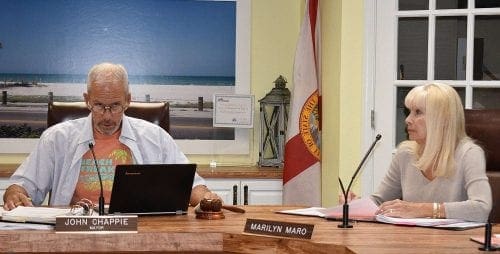
On behalf of some of her constituents, Commissioner Marilyn Maro requested the moratorium be extended for three more months, but legal justification for another extension could not be made during the Thursday, March 1 City Commission meeting.

Maro’s agenda request included a handwritten note from the “People of Bradenton Beach” seeking more regulations and additional adjustments to the land development code before the moratorium is lifted.

“We want to see an end to all party houses. We want our neighborhoods back,” the note said.

In Nov. 2016, a voter referendum mandated the commission enact a six-month moratorium on the issuance of building permits for homes containing more than four bedrooms or potential sleeping rooms. The moratorium was extended several times to allow the commission more time to develop rental regulations and other regulations intended to limit the impact vacation rentals have in residential neighborhoods.

The possibility of another extension prompted a hand-delivered letter written by attorney Aaron Thomas on behalf of the Najmy-Thompson law firm that represents several Bradenton Beach property owners.

At the request of Thomas and Mayor John Chappie, City Attorney Ricinda Perry read the letter aloud when last week’s discussion began.

“The Bert J. Harris Jr. Private Property Rights Protection Act provides a cause of action for temporary impacts on development lasting more than one year. The initial moratorium went into effect Nov. 8, 2016, well over one year ago. While the city may currently be susceptible to Bert Harris claims under this temporary impact on development provision, an extension of the moratorium for an additional three months will only solidify this fact. Should you elect to extend the moratorium an additional three months the city will undoubtedly be subject to a number of Bert Harris claims for which a monetary settlement will be the only reasonable settlement for our clients. Given this, we urge the commission to vote against the three-month extension,” the letter said.

Perry said she disagreed with the assertion that the city was currently at risk of Bert Harris claims – in part because city voters enacted the moratorium – but she agreed the city would be at risk if the moratorium was extended again.

Chappie and Commissioner Ralph Cole both noted Bradenton Beach is the only Island city not to be named in a Bert Harris claim.

“We are pleased the city made this decision,” Thomas said. “It was only to their benefit to do so. Many of our clients who have investment property in Bradenton Beach are optimistic about the city’s new leaders making fair and well-balanced decisions with respect to the vacation rental home market within the city.”

Commission discussion

Maro referenced the residents’ requests for another extension and said, “They just don’t want party houses. They’d said there’s still too many people in these houses, we’re talking 20 to 30 people. There’s still a few things that need to be adjusted.”

Perry, Chappie and City Planner Alan Garrett each expressed their views that staff, the Planning and Zoning Board and the commission had done all it set out to do when the moratorium was enacted and another extension could not be justified.

Since enacting the moratorium, the commission adopted a revised version of the original vacation rental regulations adopted in 2015 but never implemented. That registration program is underway and the new regulations take effect March 19.

Occupancy limits are established by the air conditioning load determined according to the Florida Building Code. According to Building Official Steve Gilbert, this basically equates to the same two people per bedroom plus two additional guests limits established in Anna Maria and Holmes Beach.

Bedrooms must now be labeled and adhered to when submitting building applications and rental registrations.

Side-yard trash pickup will soon be required of non-owner-occupied rentals and parking requirements have been increased. Noise complaints will be enforced by the police department as they are for any other home or business.

Pool setbacks for all residential properties have been increased and pools will now be counted as impervious surfaces when calculating the 40 percent maximum lot coverage.

Historic preservation    

The commission unanimously supported Cole’s previously-made suggestion that the commission now pursue a historic preservation ordinance similar to the city of Anna Maria’s. The intent is to encourage property owners to preserve traditional cottages and bungalows rather than demolish them and replace them with larger homes to be used as vacation rentals. A historic preservation designation helps homeowners offset the FEMA 50 percent redevelopment limits that often make it easier to build a new house than improve an old one.