


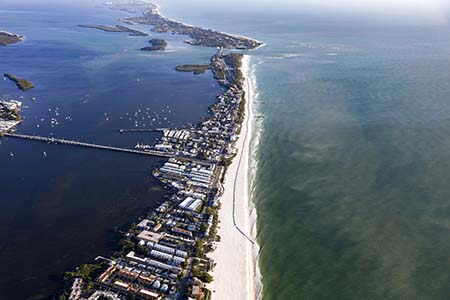
‘Sacrificial sand’ the primary goal of beach renourishment
Updated Nov. 23, 2020 – ANNA MARIA ISLAND – Before the arrival of Tropical Storm Eta, Manatee County Parks and Natural Resources Director Charlie Hunsicker shared his thoughts on the anticipated loss of the sand that would occur on Anna Maria Island’s recently renourished beaches.

“Many people who follow beach renourishment see the sand go away during a storm and say, ‘It all washes away. It’s a waste of money.’ I want everyone to understand the sands there are sacrificial. The beaches are intended to wash away. Mother Nature will come in with the energy she has and extract the sand, or take something from the Island. If it’s not the sand, it’s homes, roads and utilities,” Hunsicker said.After the Tuesday, Nov. 3 county commission meeting ended, Hunsicker discussed the public criticism that sometimes accompanies the storm-related loss of renourished beach sand.
“Many people look at that as a waste of money, but that’s exactly the plan. Sacrificial sand is what we put there. Recreation is an added attribute, but its first and foremost job is to protect the Island. That’s why it’s done and that’s what it does,” Hunsicker said.
“They were significant. But I want everyone to remember that the beach we build is titled theThe loss of beach renourishment sand was also discussed Thursday morning during the county’s post-Tropical Storm Eta virtual press conference, when Hunsicker was asked what losses were sustained in terms of beach sand.
‘Anna Maria Island Shore Protection Project’ by the (Army) Corps of Engineers. The primary purpose of our beaches is for coastal protection, to dissipate the energy of the storms. We also have very real recreation benefits and habitat benefits as well for nesting shorebirds and marine turtles,” Hunsicker said.
“We lost depth and width of beach to a near-shore and offshore sand bar. It did not wash away to the middle of the Gulf or Texas. It’s nestled below sea level about 50-60 yards offshore. It will stay that way over the winter, and in the summer, the gentler waves will slowly move it back on shore. Not all of it. We lost sand, and even under normal conditions, Anna Maria Island loses about 10 feet of width every single year,” Hunsicker said.“If a sandy beach washes away, it’s done its intended job. Without the beach, we’d be looking at Gulf-facing roads, utilities and ultimately homes that would absorb the brunt of the storm and be washed away. In this circumstance, we are quite pleased. The erosional losses we saw were the measured benefit of having the beach in place for storms just like this one,” Hunsicker said.
“I want everyone to understand the sands there are sacrificial. The beaches are intended to wash away.” – Charlie Hunsicker, Manatee County Parks and Natural Resources Director
“We fully expect the beach to respond the way it did. It’s the breaking tide that does most of the damage. When high tide rolls up over the beach it moves sand around, but it doesn’t drag it out like grabbing hold of a bedsheet and pulling it off a bed. Actually, high tides and flooding on the beach is a good thing. We lose the back berms and dunes, but that sand is pulled from the dunes and distributed across the beaches,” Hunsicker said.
“We’ve been asked to assess damages like any other tropical storm or hurricane, and to rough estimate the volume lost. If there is a congressional add to the budget to address damages from this hurricane season, our beaches there will be eligible for the Corps to return with a new contractor and put that sand back on the beach. That isn’t very often, but that’s how, after Hurricane Sandy (in 2012), we got relief. If you remember Hurricane Irma (in 2017), that is why the Corps is here now, to return the whole beach back to its starting elevations and widths that were there before the storm,” Hunsicker said.
“We may go through yet another episode if congressional money is available. We won’t be able to afford paying for it ourselves – or the state of Florida for that matter. But we’re always optimistic. Certainly, there were damages up and down the southwest coast of Florida and on the east coast – Miami and Key West. So, if there’s a hurricane relief bill coming to Congress, the Army Corps will make efforts to apply that funding to restore the lost sand we just suffered in the last three days,” Hunsicker said.