Tag: Christmas bird count

AMI Christmas Bird Count reveals some surprises

AMI Christmas Bird Count reveals some surprises

ANNA MARIA ISLAND – The 125th Annual Audubon Christmas Bird Count on Anna Maria Island was completed on Dec. 29 and counters found a few surprises.

“We were interested in what impact the hurricanes would have on this year’s numbers, but we actually logged more species than last year,” counter Bill Pelletier wrote in an email to The Sun.

Counters viewed 54 species of birds on the north end of the Island, including a new addition – a wild turkey.

“We had an unexpected addition of a wild turkey on the island,” Pelletier wrote. “Kitty (counter Kitty O’Neil) found it back in April and it is still around. This is the only one ever reported out here, in the wild.”

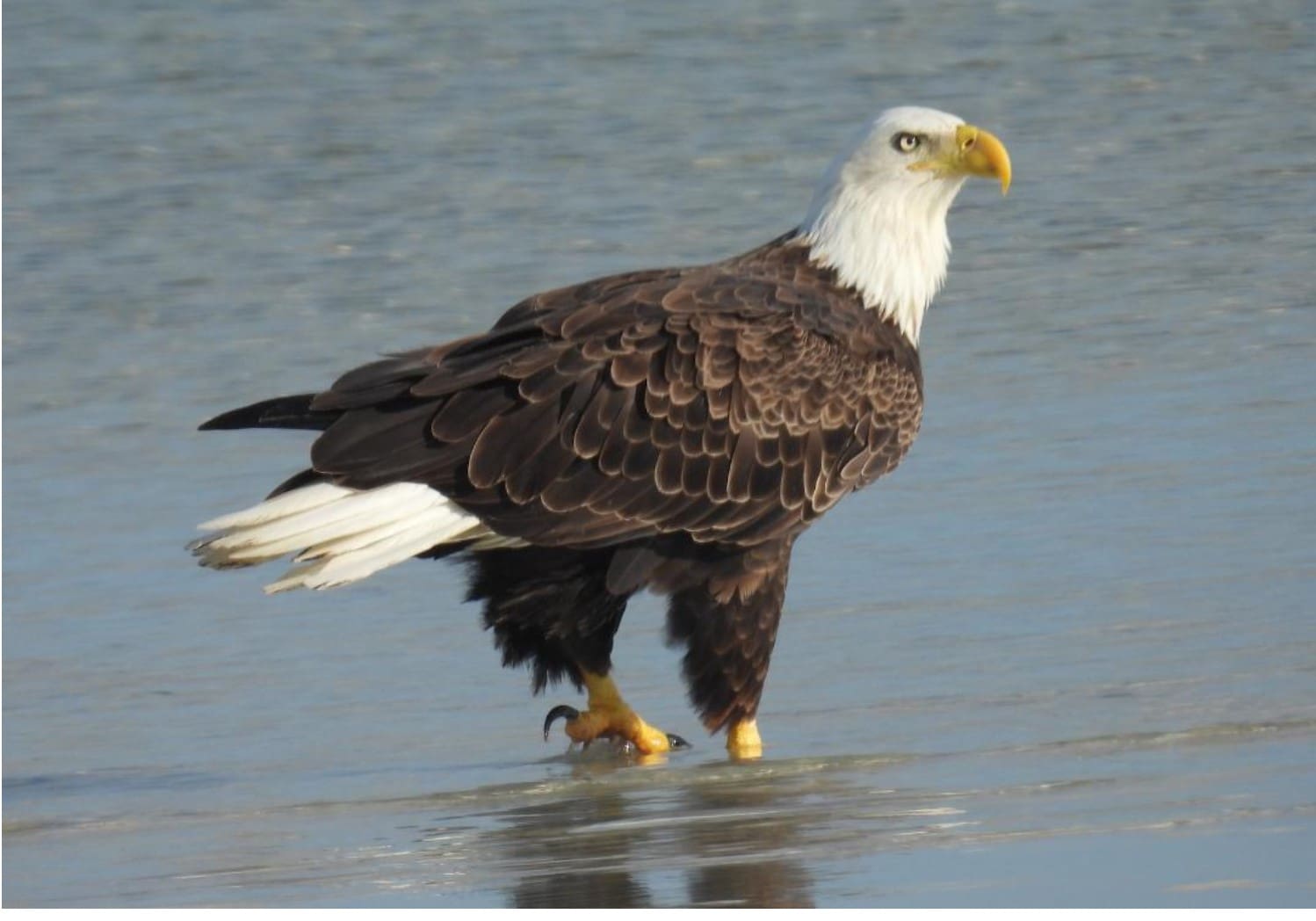
Pelletier wrote that one of a pair of nesting bald eagles didn’t make it through the storms.

“The other eagle is still around and advertising for a mate,” he wrote.

Counters recorded sighting 655 individual birds. The highest count of any species was 71 brown pelicans. Fourteen osprey were counted at the north end of the Island.

The count occurred in the Ft. DeSoto circle, a 15-mile diameter circle encompassing the north end of Anna Maria Island and Passage Key. In 1905, President Theodore Roosevelt established Passage Key National Wildlife Refuge to preserve nesting colonies of native seabirds and wading birds.

While the final numbers haven’t been tallied for the region, William Kaempfer said about half of the count’s total was found on Anna Maria Island.

“That included three species not seen across the channel in the Ft. DeSoto peninsula – brown-headed cowbird, gray catbird and tufted titmouse,” Kaempfer wrote.

The Audubon Christmas Bird Count has a long history. On Christmas Day 1900, ornithologist Frank M. Chapman, an officer in the newly-created Audubon Society, proposed a “Christmas Bird Census” that would count birds during the holidays rather than hunt them. The bird count is now held in locations throughout North America.

“The data collected by observers over the past century allow Audubon researchers, conservation biologists, wildlife agencies and other interested individuals to study the long-term health and status of bird populations across North America. When combined with other surveys such as the Breeding Bird Survey, it provides a picture of how the continent’s bird populations have changed in time and space over the past hundred years,” according to Audubon.org. “The long term perspective is vital for conservationists. It informs strategies to protect birds and their habitat, and helps identify environmental issues with implications for people as well.”

In addition to Pelletier, O’Neil and Kaempfer, Tom Bisko participated in the bird count.
Sing along with the Christmas Bird Count

Sing along with the Christmas Bird Count

ANNA MARIA ISLAND – On the eighth day of Christmas, the Audubon Society counted 12 palm warblers, 11 (plus eight) northern mockingbirds, 10 red-bellied woodpeckers, nine blue-gray gnatcatchers, eight common loons, seven house finches, six snowy egrets, five white ibis, four (plus two) house sparrows, three American white pelicans, two wood storks and a lesser black-backed gull.

The birds were tallied on a warm Jan. 2 by volunteers with the Manatee County Audubon Society during the annual Fort De Soto Christmas Bird Count, which includes birds on Anna Maria Island.

Sing along with the Christmas Bird Count
A spotted sandpiper, a shorebird that winters in Florida, was found during the Christmas Bird Count. – Kathryn Young | Submitted

The team of Stu Wilson, John Ginaven, Kathryn Young, Marcy Klein and Pam Koepf scoured the Island north of 46th Street and found shorebirds commonly seen on AMI’s coastline, but also unusual finds, such as two bald eagles.

Like birds? Try the Audubon app

They identified 48 species, a little low compared to the average of 54 species, Wilson said, attributing the decrease to continued warm weather in the northern U.S., keeping some birds from migrating south.

Each individual count takes place in a 15-mile-wide circle and is led by a compiler responsible for safely organizing volunteers and submitting observations to Audubon. Within each circle, participants tally all birds seen or heard that day – not just the species, but individuals, to provide a clearer idea of the health of that particular population.

Sing along with the Christmas Bird Count
A red-breasted merganser swims off Anna Maria City Pier looking for fish during the Christmas Bird Count. – Kathryn Young | Submitted

The 112 years’ worth of data collected during the Christmas Bird Counts contributes to one of two large sets of data that inform ornithologists and conservation biologists about what conservation action is required to protect birds and their habitats.

Here’s the rest of the AMI bird numbers:


sandwich tern 180

fish crow 140

European starling 130

laughing gull 130

sanderling 110

royal tern 87

willet 57

ring-billed gull 45

brown pelican 42

common grackle 32

double-crested cormorant 24

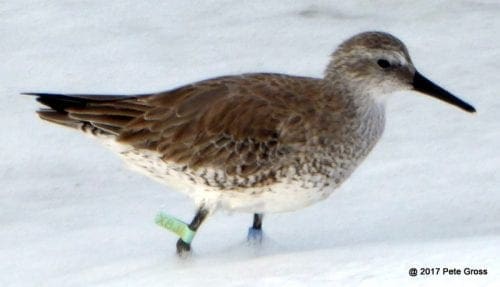
red knot 24

mourning dove 23

osprey 21

Eurasian collared-dove 20

herring gull 20

Forster’s tern 18

nanday parakeet 17

brown-headed cowbird 14

ruddy turnstone 9

great blue heron 8

turkey vulture 6

red-breasted merganser 5

rock pigeon 5

great egret 3

downy woodpecker 2

black-bellied plover 2

prairie warbler 2

American kestrel 1

red-shouldered hawk 1

spotted sandpiper 1

magnificent frigatebird 1

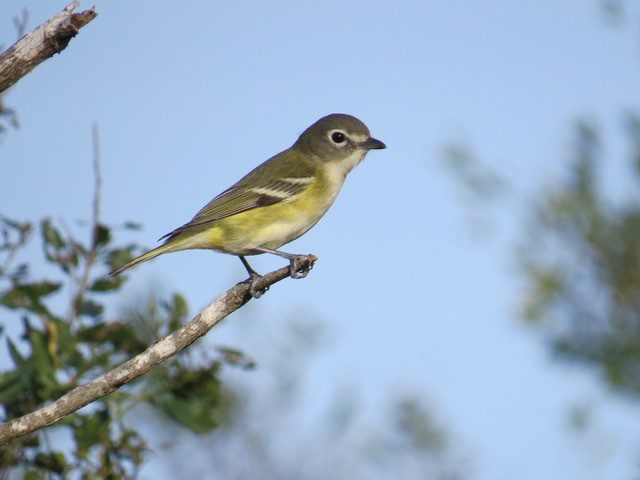
blue-headed vireo 1

gray catbird 1

yellow-rumped warbler 1

Red knot

Christmas bird count results in

There were no French hens, geese a-laying, swans a-swimming or partridges in pear trees, but local Audubon volunteers found plenty of birds in the 118th Christmas bird count on New Year’s Eve.

Six birders found more than 800 birds of 51 species in the count, including shorebird species familiar to beachgoers like terns, sanderlings, red knots, plovers, gulls and brown pelicans, which topped the list of most commonly seen birds at 94 individuals.

Fish crows took second place, with 69 observed. Mourning doves placed third, with 64 counted, while turkey vultures were nudged into fourth place at 63.

The highlight was the discovery of two bald eagles, said John van Zandt, of Audubon’s Fort DeSoto Circle, which includes Anna Maria Island.

No one spotted a razorbill, he said – the seabird, which resembles a penguin, was added to the list when several unexpectedly migrated here in 2013 from the North Atlantic, possibly due to storms.

Other common birds observed were ducks, sparrows, warblers, starlings, crows, jays, kestrels, woodpeckers, doves and pigeons.

The annual count began in 1900 when Dr. Frank Chapman, founder of Bird-Lore, which evolved into Audubon magazine, suggested an alternative to holiday hunts, proposing that people count birds instead of killing them.

Since then, the National Audubon Society has provided data on trends in bird populations in the U.S., Canada, Central and South America, Bermuda, the West Indies and the Pacific Islands.

Like canaries in coal mines, birds are indicators of overall environmental health, according to Audubon, which has declared 2018 the Year of the Bird, marking the centennial of the Migratory Bird Treaty Act with National Geographic, the Cornell Lab of Ornithology and BirdLife International.

Visit www.BirdYourWorld.org to learn simple ways to help birds this year.

Related coverage

Bird Tips

Flippers and Feathers